02
ATCS-GHReinforcement learning for traffic control
AI that gives Accra's fixed-timer traffic lights a brain. A reinforcement-learning controller that cuts simulated wait times by up to ~90% on peak-hour scenarios.
The problem
Lights that can't see the road
Ghana loses an estimated GH¢4.5 billion a year to traffic congestion. Most signalised junctions in Accra run on fixed timers that can't react to real traffic, and neighbouring lights don't coordinate, so clearing one junction just queues cars at the next.
Source: “The Cost of Gridlock,” Glima Research policy brief, February 2026.
The solution
A learning controller, no new hardware
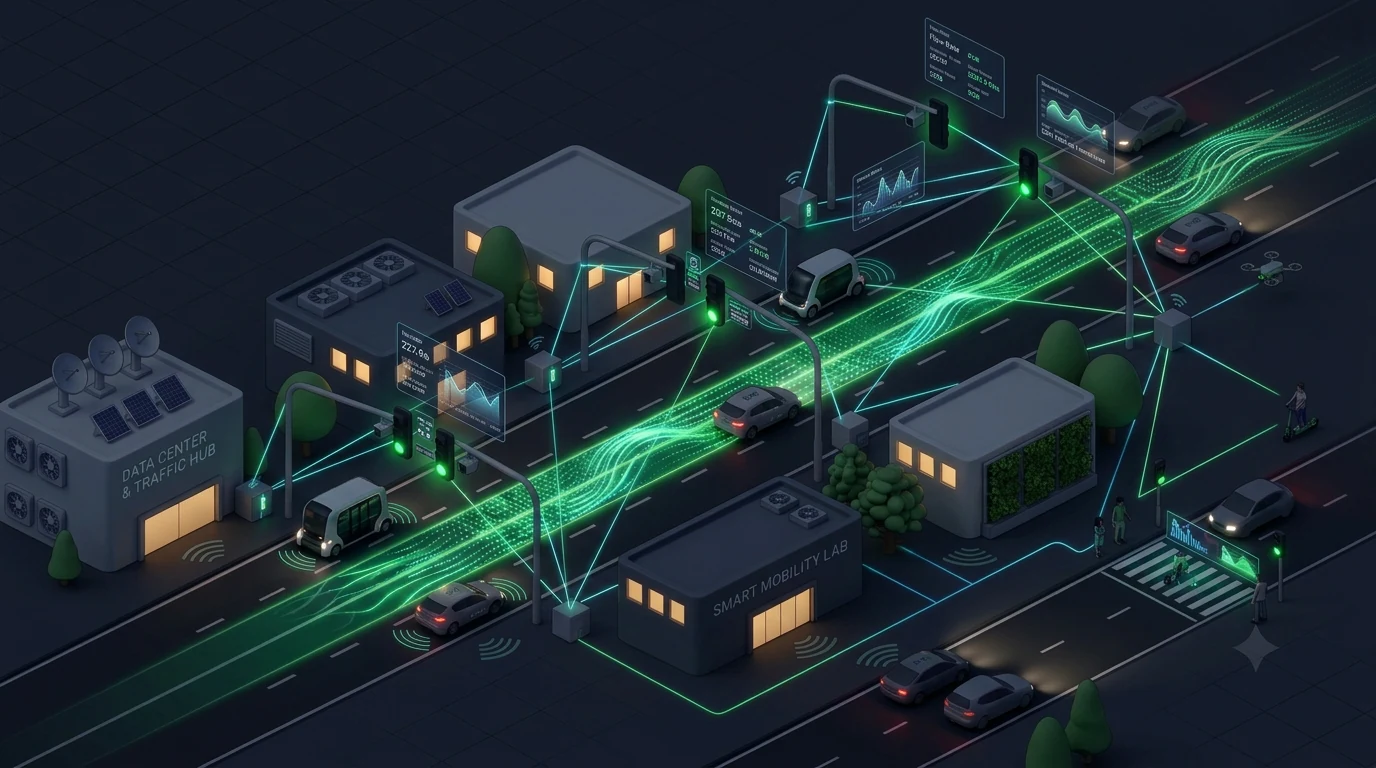
A reinforcement learning agent (Double-DQN) watches each junction as it happens, reading queue lengths, speeds and wait times, then picks the next signal phase every few seconds.
Along a corridor, the agents learn to line up their greens so traffic you just cleared is not stopped again at the next light. It runs on the signals already standing at the junction.
Results
Measured in simulation
- 85–92% reduction in average vehicle wait time versus a realistic fixed-timer baseline, on peak-hour scenarios
- Validated across 8 demand scenarios × 5 random seeds. It improves on every single one, not just on average
- Trains in about 2 hours on a laptop
- Fully open-sourced
All figures are compared against fixed-time control, which is what most Accra junctions actually run today. This is simulation-validated research, not a field deployment: no pilot, partnership, or city engagement exists yet. Outreach to transport authorities is a future goal.
Stack
How it's built
- Python
- PyTorch (Double-DQN)
- SUMO traffic microsimulation
- Godot 4 (real-time 3D visualiser)
- Flask
- WebSocket

Contact
Let's build something.
Investors, city and transport people, partners, or someone who just wants to ask about the work. Email lands with me directly and I answer.
valiborntech@gmail.com